



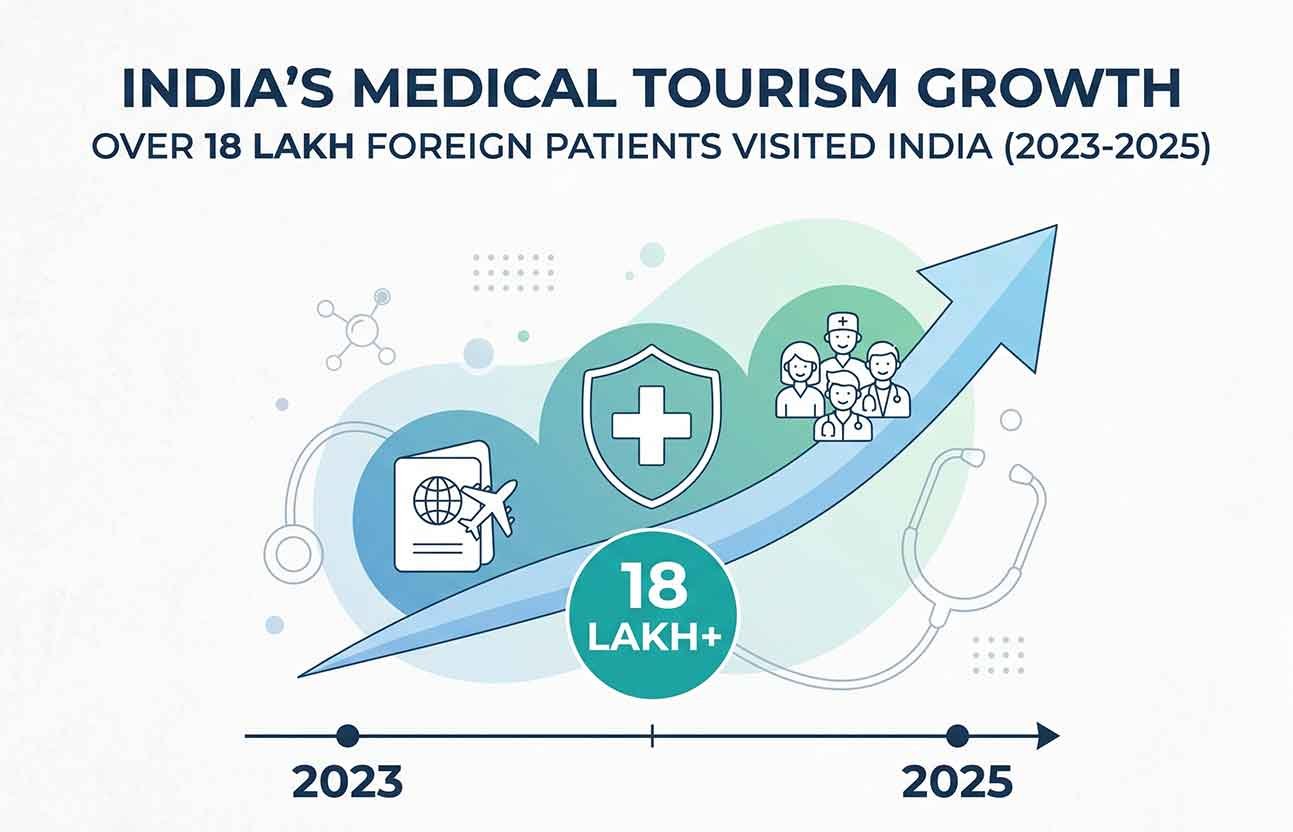
India is strengthening its position as an important destination for international healthcare, with more than 18.11 lakh foreign nationals visiting the country for medical tourism between January 2023 and December 2025, according to data shared with the Indian Parliament. The figure highlights the growing demand for medical treatment in India and the country's expanding role in the global medical tourism sector.
The growth is not simply about the number of international patients travelling to India. It reflects a broader shift in how patients evaluate healthcare across borders, considering factors such as access to specialised doctors, hospital infrastructure, treatment costs, waiting periods, technology, rehabilitation and overall patient support.
For patients from the GCC, Africa, the Middle East, the UK and other international markets, India can offer access to a wide range of medical specialties while also providing different treatment options across major cities and healthcare destinations.
What Does the 18.11 Lakh Figure Tell Us About Medical Tourism in India?
According to data from the Ministry of Home Affairs cited in the parliamentary response, 18,11,950 foreign nationals travelled to India on medical tourism-related visas between January 2023 and December 2025.
This three-year figure demonstrates the scale at which international patients are seeking healthcare services in India.
Government data also shows that India recorded 659,356 foreign tourist arrivals for medical purposes in 2023 and 644,387 in 2024. For January to November 2025, the provisional figure was 450,633.
The numbers indicate that medical travel has become an established component of India's international tourism and healthcare ecosystem.
At the same time, the government has clarified that it does not maintain state-wise data on medical tourism revenue, meaning the available statistics should be interpreted primarily as indicators of international patient arrivals rather than the total economic value of the sector.
Why Are International Patients Choosing India for Medical Treatment?
The decision to travel to another country for healthcare is usually influenced by several factors rather than a single consideration.
India has a large healthcare ecosystem that includes multi-specialty hospitals, specialist doctors, diagnostic centres, rehabilitation facilities and treatment centres offering a broad range of medical procedures.
International patients may travel to India for treatments including cardiac procedures, orthopaedic surgery, cancer care, neurological treatment, organ transplantation, fertility treatment, ophthalmology, dental procedures and cosmetic surgery. Government information identifies cardiac surgery, orthopaedic procedures, cancer treatment, organ transplants, neurological interventions and cosmetic surgery among areas for which international patients travel to India.
For patients who have limited access to certain specialised procedures in their home countries, India's breadth of medical expertise can be an important consideration.
Treatment Cost Is One of the Factors Behind Medical Tourism in India
Healthcare costs vary significantly between countries, hospitals and treatment types.
For some international patients, India can provide treatment options at a lower overall cost than comparable private healthcare in certain high-cost countries. However, cost should not be considered in isolation.
The actual expense of medical treatment depends on the procedure, hospital, surgeon, medical condition, length of hospitalisation, diagnostic investigations, medicines, accommodation and follow-up care.
A lower quoted treatment cost does not automatically mean that one hospital is better than another. Patients should compare the quality of care, doctor qualifications, hospital accreditation, infrastructure, treatment outcomes, patient services and aftercare alongside the financial estimate.
Access to Specialist Healthcare
Another important reason international patients consider medical treatment in India is the availability of specialist care.
Large Indian hospitals commonly operate multidisciplinary departments where specialists from different medical fields can collaborate on complex cases.
This can be particularly relevant for patients with conditions requiring multiple stages of evaluation and treatment.
Before travelling, patients should obtain a medical opinion based on their medical records and confirm whether the selected hospital has the appropriate specialist and facilities for their particular condition.
India’s Medical Tourism Ecosystem Is Becoming More Structured
The growth of medical tourism has encouraged the development of a broader ecosystem around international healthcare.
Medical tourism involves much more than hospitals. It can include doctors, diagnostic providers, medical facilitators, hotels, airlines, transport services, visa services, rehabilitation providers and other support organisations.
The Government of India has described the medical tourism ecosystem as involving hospitals, facilitators, hotels, airlines, regulatory agencies and government bodies.
This is important because an international patient's journey does not begin when they enter the hospital. It starts with identifying the right treatment and hospital and continues through consultation, travel, admission, treatment, discharge, rehabilitation and follow-up.
Easier Medical Visa Facilities for International Patients
Visa accessibility is another important part of international medical travel.
The Government of India has introduced e-Medical Visa and e-Medical Attendant Visa facilities to facilitate travel for medical treatment. Government information states that these facilities have been extended to nationals of a large number of countries.
The availability of medical and attendant visa categories can make the process more structured for patients travelling with family members or caregivers.
However, visa requirements can change, and patients should always verify the current requirements through official government channels before making travel arrangements.
The Growth of Medical Tourism and the “Heal in India” Approach
India has also been working towards creating a more coordinated medical value travel ecosystem.
The government has developed a National Strategy and Roadmap for Medical and Wellness Tourism and has promoted initiatives designed to strengthen India's position in international healthcare.
The broader approach aims to make the patient's journey easier by connecting healthcare, medical travel, visa facilitation, information and support services.
Government initiatives have also included the development of a Medical Value Travel portal intended to provide international patients with information about healthcare providers and related services.
The objective is to move beyond simply attracting patients and towards creating a more complete international healthcare experience.
Why Medical Tourism Is Important for GCC Patients
The GCC region is an important market for international healthcare, particularly for patients looking for specialised treatment outside their home country.
Patients from countries such as Saudi Arabia, the United Arab Emirates, Qatar, Oman, Kuwait and Bahrain may consider several international healthcare destinations depending on the medical specialty, availability of treatment, physician expertise, cost and travel convenience.
India's geographical accessibility from the Gulf, established international air connections and large healthcare ecosystem can make it a practical option for some patients.
For GCC patients, other considerations can also be important, including Arabic-language assistance, airport transfers, accommodation for family members, dietary requirements, visa support and communication with hospitals.
A medical tourism provider can play an important role in coordinating these non-clinical aspects while the actual medical decisions remain with qualified healthcare professionals.
Kerala’s Role in India’s Medical Tourism Landscape
While cities such as Delhi, Mumbai, Chennai, Bengaluru and Hyderabad have become well-known medical tourism destinations, Kerala is also developing as an important healthcare and wellness destination.
Kerala combines modern healthcare facilities with a long-standing reputation for Ayurveda, rehabilitation and wellness.
Patients travelling to Kerala can find healthcare services across several specialties, including orthopaedics, cardiology, oncology, neurology, fertility care, ophthalmology and rehabilitation, alongside traditional Ayurveda and wellness programmes.
Medical tourism in Kerala can therefore appeal to patients looking for both specialised modern healthcare and structured wellness or rehabilitation services.
Kochi is particularly relevant for international patients because of its international airport, healthcare infrastructure and connectivity with other parts of Kerala.
Medical Tourism Is More Than Finding a Cheap Treatment
One of the biggest misconceptions about medical tourism is that international patients travel only because treatment is cheaper.
In reality, the decision can involve several interconnected factors.
Patients may be looking for access to a particular specialist, a specific surgical technique, advanced diagnostic technology, shorter waiting periods, comprehensive rehabilitation or a second medical opinion.
For some patients, treatment affordability is important. For others, access to expertise or a procedure unavailable in their home country may be the primary reason for travelling.
Therefore, choosing a medical destination should involve a comprehensive evaluation rather than a simple comparison of treatment prices.
What International Patients Should Check Before Choosing a Hospital in India
Choosing the right hospital is one of the most important parts of planning medical treatment abroad.
Patients should investigate whether the hospital has the relevant specialty and whether the doctor treating them has appropriate qualifications and experience in the required procedure.
It is also important to understand what is included in the treatment quotation. Hospitalisation, surgeon fees, anaesthesia, diagnostic tests, medicines, implants, ICU care and follow-up may not always be included in the initial estimate.
International patients should also ask about expected recovery time, accommodation after discharge, rehabilitation requirements and follow-up arrangements after returning home.
Most importantly, patients should provide complete medical records before travelling so that the treating team can properly evaluate the case.
The Importance of Medical Coordination for International Patients
Travelling abroad for treatment can be complicated, particularly for patients undergoing surgery or long-term treatment.
A medical coordinator can help organise communication between the patient and hospital, arrange appointments, collect medical reports, coordinate travel logistics and provide assistance during the patient's stay.
This can be particularly useful for patients who are unfamiliar with India's healthcare system or who are travelling with family members.
However, medical coordination should not be confused with medical decision-making. Diagnosis, treatment recommendations and clinical decisions should always be made by qualified medical professionals.
India’s Medical Tourism Growth: What It Means for the Future
The 18.11 lakh foreign nationals recorded during 2023–2025 demonstrate that international healthcare is already a significant component of India's cross-border travel ecosystem.
Government data from 2026 also reported 507,244 foreign nationals arriving in India specifically for medical treatment during 2025, representing approximately 5.5% of total foreign tourist arrivals that year. The leading source markets included Bangladesh, Iraq, Uzbekistan, Somalia, Turkmenistan, Oman and Kenya.
These figures suggest that India's medical tourism sector is continuing to evolve.
The future of medical tourism will likely depend not only on attracting more patients but also on improving the complete patient experience — from the first online consultation to hospital treatment, rehabilitation, follow-up and return travel.
Medical Tourism in India: Making an Informed Decision
The growth of medical tourism in India creates more choices for international patients, but more choices also mean patients need to conduct careful research.
A good medical tourism decision should consider the medical condition, treatment options, specialist expertise, hospital infrastructure, expected cost, travel requirements, recovery period and long-term follow-up.
Patients should avoid choosing a hospital solely because of advertisements, online reviews or the lowest quotation.
Instead, the focus should be on appropriate medical expertise, transparent communication, patient safety and continuity of care.
How Medinglo Supports International Patients Seeking Treatment in India
At Medinglo, we understand that travelling to another country for medical treatment involves much more than finding a hospital.
We help international patients explore suitable healthcare options in India and Kerala, coordinate consultations with hospitals and doctors, organise medical documentation and assist with the practical aspects of the treatment journey.
From the initial enquiry and medical evaluation to travel coordination, hospital admission and follow-up planning, the goal is to make the international patient's healthcare journey more organised and transparent.
The medical treatment itself remains under the care of qualified doctors and hospitals, while Medinglo focuses on helping patients navigate the journey around their treatment.
Frequently Asked Questions
How many foreign patients came to India for medical tourism between 2023 and 2025?
According to data shared with the Indian Parliament, 18,11,950 foreign nationals travelled to India on medical tourism-related visas between January 2023 and December 2025.
Why do international patients choose India for medical treatment?
Patients may choose India because of the availability of specialist doctors, advanced hospital infrastructure, a wide range of medical specialties, treatment affordability in some cases and access to procedures that may have longer waiting periods or limited availability elsewhere.
Which treatments do international patients commonly seek in India?
International patients travel to India for a wide range of treatments, including cardiac surgery, orthopaedic procedures, cancer treatment, organ transplantation, neurological treatment, fertility care, ophthalmology, dental procedures and cosmetic surgery.
Is Kerala a medical tourism destination?
Yes. Kerala has developed healthcare and wellness infrastructure alongside its established Ayurveda tradition. Cities such as Kochi provide access to hospitals, specialist care, international connectivity and accommodation for international patients.
Can GCC patients travel to India for medical treatment?
Yes. Patients from GCC countries including Saudi Arabia, UAE, Qatar, Oman, Kuwait and Bahrain can explore medical treatment options in India, subject to applicable visa and travel requirements.
Does India provide a medical visa for international patients?
India provides e-Medical Visa and e-Medical Attendant Visa facilities for eligible international travellers. Visa eligibility and requirements can change, so patients should verify the latest information through official government sources before travelling.
Conclusion
The arrival of more than 18.11 lakh foreign nationals for medical tourism between 2023 and 2025 is a significant indicator of India's growing role in international healthcare.
India's combination of specialist medical expertise, healthcare infrastructure, diverse treatment options, international connectivity and comparatively competitive treatment costs has made it an increasingly considered destination for patients from around the world.
For patients from the GCC, Middle East, Africa, the UK and other international markets, the decision to travel to India should be based on careful evaluation of medical expertise, hospital quality, treatment suitability, cost, patient support and aftercare.
As medical tourism continues to evolve, the focus is increasingly shifting from simply providing treatment to creating a complete and patient-centred healthcare journey.
For those considering medical treatment in India or medical tourism in Kerala, professional medical advice and thorough research should always be the first steps before making a treatment decision.
Medical Disclaimer: This article is for general informational purposes only and does not constitute medical advice. Treatment suitability, diagnosis and medical decisions should always be determined by qualified healthcare professionals after reviewing the patient's individual medical history and condition.